
Matthew Wright’s Album Cracked Glaze
The album featuring Ensemble Klang, Spheric Totemic & Sofia Jernberg is released on 15 May 2026 on False Walls.
Liner notes by Nate Wooley
The Flaneur’s Mission
Matthew Wright’s Cracked Glaze and the Sustenance of Immersion
The walks started as a remedy for my pandemic cabin fever. Based on Nan Shepherd’s The Living Mountain, a poetic description of the twentieth-century Scottish writer’s hikes through the Cairngorm mountains, I’ve traced the same route in Brooklyn for almost five years: up a sycamore-lined row of crumbling, three-family homes to a small side-street jog, before taking a left and shooting straight up two-miles of city blocks to Prospect Park. I’d sit on a bench, then head back the exact same way, passing the same apartment buildings, crossing the same larger and smaller streets, smelling the same smell of Mexican bakeries. I maintain this practice, and every day I stroll through a world that is concrete and memorized. But my experience of these four miles has become a dense thicket of experience that changes shape depending on the season, the people or animals that I encounter, or my mood. The city blocks don’t objectively change, but my experience of living in them subjectively wrestles them into a new shape and hue every time I walk down my front steps.
There’s something about Matt Wright’s Cracked Glaze that rhymes neatly with this phenomenological shift from objective to subjective and back, a process the anthropologist Mick Taussig calls enchantment. Although Wright’s metaphor is pottery—and how the cracks in an otherwise perfect glaze become the all-important markers of difference and beauty within a very real piece of craftsmanship—and not a wandering walk, I believe our thinking is parallel. We’re both understanding his composition as a balance between the repeatable and the spontaneous—the rigid form and its malleable content.
Set form and spontaneous content have danced together for millennia: narrative shaped the sung melodies of ancient music; florid improvisations grew out of the semiology of 17th century figured bass notation; and jazz structured itself on a grid of harmonies and time with ever-changing melodies. The last ten years, however, have seen contemporary composers embracing the unknown of improvisation as content within complex compositional forms. Inspired by the AACM, the British scene of the 1960s, and/or the New York School, the promise of the new found in improvisation is a strong motivator for many young composers to give up some of their authorship to the spontaneity of their performers. This has often resulted in a productive blurring of the line between the feral and the mannered. But centering improvisation and improvisors within a composition’s form, presents the insensitive composer with a series of subtle but artistically devastating pitfalls. Cracked Glaze is a powerful example of a composer understanding these pitfalls and creatively avoiding them while making music worth returning to again and again.
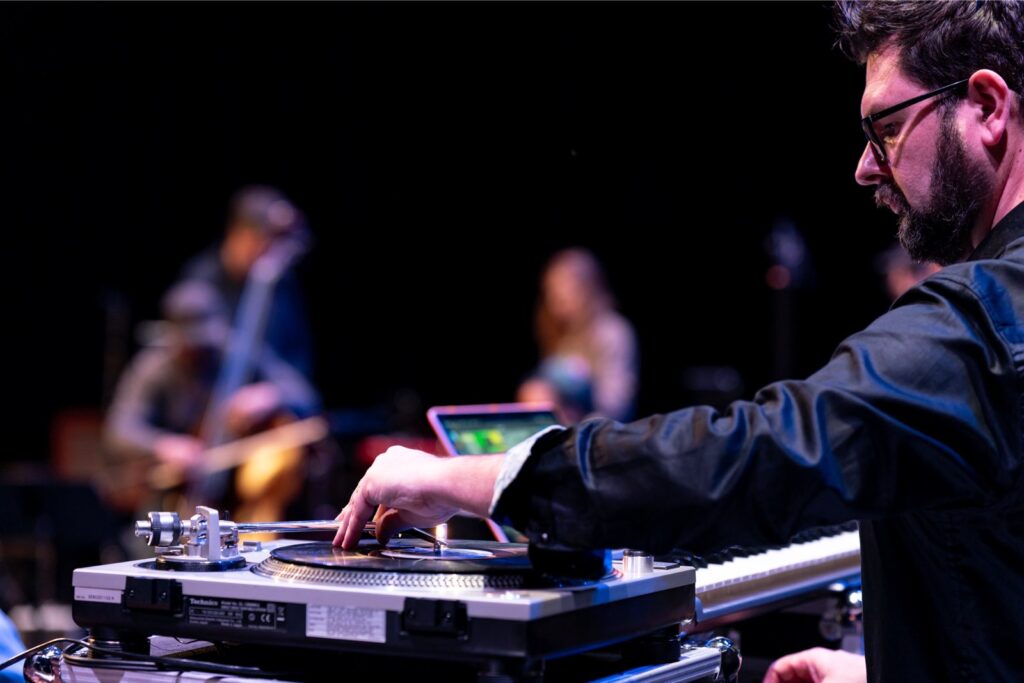 Matthew Wright
Typically a composition works with form as a container which then has musical information poured into it, as in the cyclical AABA song or the developmental sonata-allegro movement. In Cracked Glaze, the form is structurally conceived as a melodic center-post around which Wright’s composing and the improvisation of the ensemble is built. Wright calls this organizing feature the “spine” of the piece, and it’s an apt description: his slowly descending line continually falls and repeats, truncating and expanding as it makes its way down the middle of the music. Rather than providing the dimensions of a musical box, Wright’s “spine” outlines an audible path around which the improvising musicians can veer from and return to while signaling to the listener that, no matter what happens sonically, forward progress is being made.
To show why the “spine” is special, allow me to return to the subject of walking. Following the same path—be it along the streets of Brooklyn or over the Cairngorms of Scotland—with the intention of finding a new meaning and depth in its surroundings requires not only something of the attention of the walker, but also of the construction of their path. If the route is too difficult, its complexity destroys the flaneur’s mission as they focus their attention on finding their way rather than being able to dig deeply into the changes in the foliage on a tree or a new addition to a family of feral cats. Using repetition to outline a form works in much the same way. Basing a composition around a musical idea that isn’t both easy to reproduce, and ultimately hummable, forces the musicians and listeners to constantly keep their auditory attention fixed on tracking its complexity. Wright’s “spine” form is wonderfully catchy without overshadowing the rest of the music. The timing and method of his meager manipulations are done with such care that the listener gets just the slightest sensation of change as they allow their ears to turn to the piece’s other elements. This is one of the beauties of Cracked Glaze and is so subtle that it may be overlooked without spending time listening to the piece again—Nan Shepherd would be proud—and again.
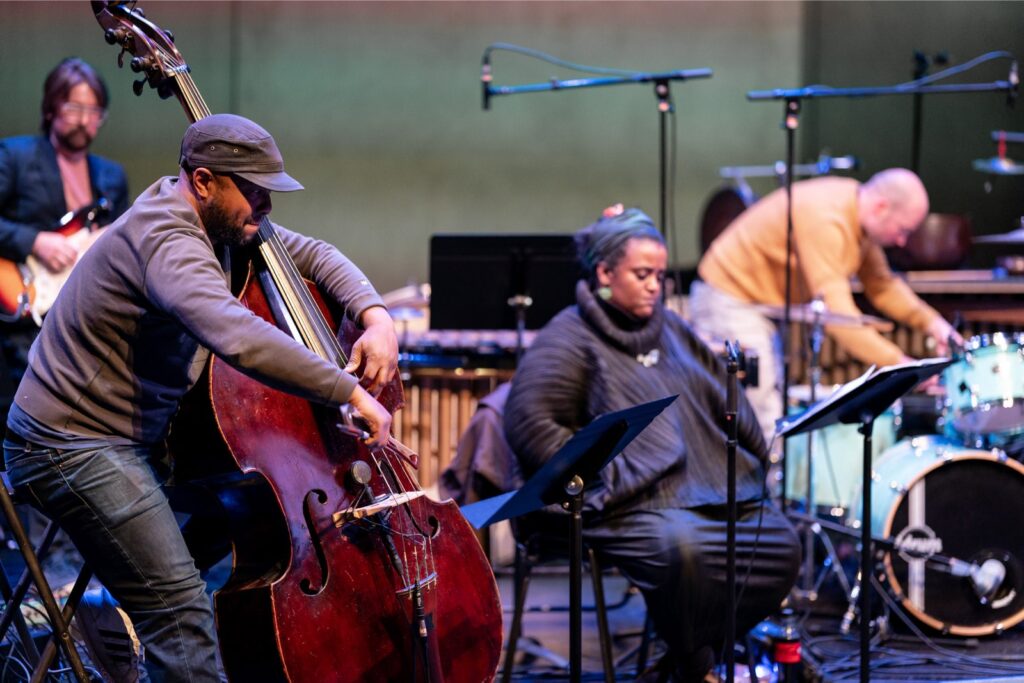 Pete Harden, Neil Charles, Sofia Jernberg
But what of content? Cracked Glaze, as a musical composition, is defined by Wright’s “spine” and his other notated themes, such as the brass glisses, micro-figures in the keyboards and mallets, and the marking-off of the concert bass drum. These ensemble moments make up a skeleton on which improvisations will be laid on as flesh. To use Wright’s metaphor, the score could be seen as perfectly fired pottery: repeatable and flawless. But what’s the use in perfection? As beautifully constructed as Wright’s score is, would it be interesting to hear only those moments, flawlessly executed within his time code? Perhaps. But it’s obvious that Cracked Glaze seeks something different. It is a vase begging for the personality given by a few well-placed cracks. Situating improvisation amid set compositional elements can, in the best circumstances, provide a musical complexity only rarely obtained with a pencil and paper. But relying on an improviser to fill in the details of a form in real time comes with the risk that the composition loses itself in the hysterical virtuosity of an improvisor “doing their thing.”
There are such things as uninteresting cracks, just as there are such things as uninteresting walks. It doesn’t mean either experience is objectively bad—the crack could be attractive, the walk sunny and warm—but the pleasure we receive from them doesn’t necessarily validate itself as an experience worth remembering. The composer wants, and the listener needs, something to mark that moment as special. Engineering a sense of this ambiguous “something special” is at the center of choosing the improvisors for a piece such as Cracked Glaze. If you involve players that rely on slick virtuosity or a musical vocabulary cynically designed to “move” the listener, your piece will be pretty, but inane. If you go hard the other way, giving free reign to an improvisor that is radical but less than sensitive, your musical content may become a series of sounds that are fascinating in themselves but unrelated to each other and the piece you have worked so hard to erect.
The chosen players have to be flexible, sensitive, and egoless. And, again, Wright has made the correct move in asking Sofia Jernberg, Alex Hawkins, Neil Charles, Mandhira de Saram, Joey Marijs, and Stephen Davis to take on the not-for-the-faint-of-heart job of tapping the “cracks” into his piece. If you’re familiar with their world of spontaneity and strangeness, you will already know these names, and their performances on this disc are likely to give you the self-satisfied warmth of hopes fulfilled. If you are new to their music, however, what you are about to discover is something I’d call magic if I didn’t know how much preparation and work is required to be an improvisor of their caliber.
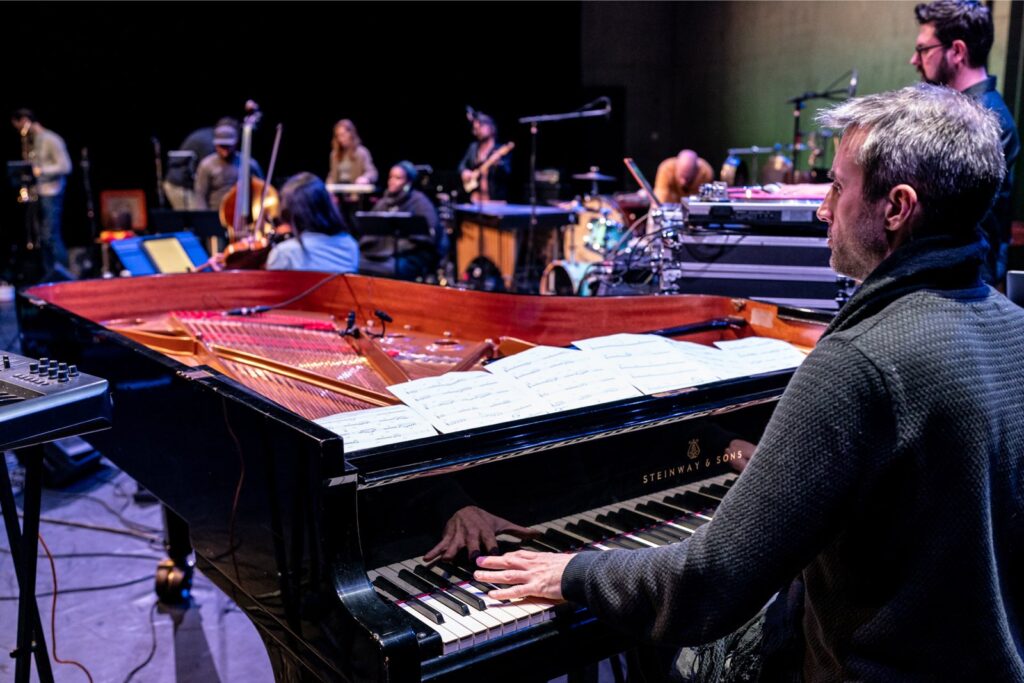 Alexander Hawkins
Another consideration in choosing performers is the balance of their improvisational languages. Hearing stylistically similar musicians improvise one after the other is about as interesting as sitting through a half dozen actors reading the same Lord Byron poem, each louder than the last. The wonderful tension of Cracked Glaze exists within, among other things, the push and pull of each player’s syntactical funkiness. Perhaps the most dramatic example of this is Hawkins’ Herbie Hancock-esque rollick down the middle of the piece’s central spine. His modern jazz acrobatics and extended harmonies are stunning (unsurprising coming from Hawkins), but his solo would only be worth a passing mention if it didn’t play so perfectly against the tart sound worlds created by Spheric Totemic and the always-almost-too-painfully-human quality of Jernberg’s voice. It’s the careful curation of artists and their care in bringing what is unique to them to the piece that ultimately makes Cracked Glaze work.
With form and content taken care of, there is one final trap to be negotiated: documentation. Composition and improvisation are saddled with different expectations, histories, and philosophies when it comes to recording. Composition’s leaning toward reproducibility favors precision, with seemingly small musical choices like Pierre Boulez’s slightly slow rendering of Beethoven’s Fifth Symphony taking on outsized importance. On the other hand, improvisation is geared toward capturing the ephemerality of once-in-a-lifetime inspiration—lightning in a bottle. Wright has recognized the opportunity to create something more than a mimesis of live performance. He subtly layers post-recording and time-expansion effects throughout, not as a thick coat of electronics over what is a truly delicate and wild and wonderful live performance, but as a subtle luster within the sound itself.
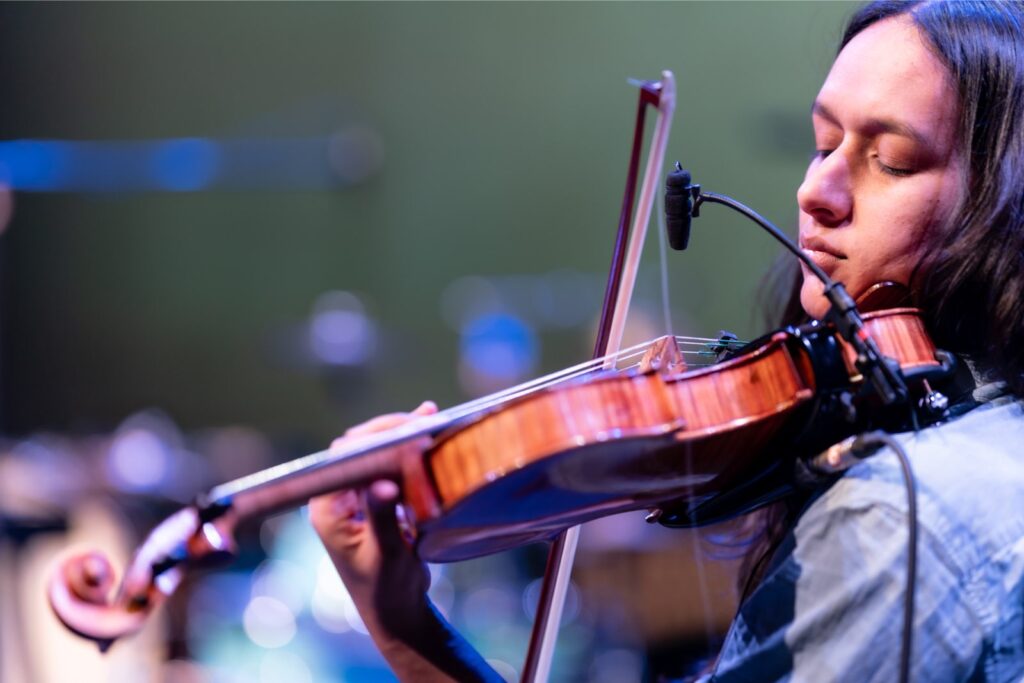 Mandhira de Saram
All the post-production in the world, however, will not enliven a poor, or apathetic, performance. And Ensemble Klang deserves more than this belated credit as one of those rare ensembles that can negotiate complex notated music with accuracy and elegance while maintaining a sense of danger: like threading a needle while tossing a match onto a bonfire. The metaphors are odd, but I won’t apologize for their color or their accuracy, because what Klang is doing is rare and wonderful both here and throughout their two decades. They are geniuses at turning the crazy idea into something that sounds completely natural and organic.
In the end, this whole recording is rare and wonderful. There are the reasons listed above—Wright’s deft handling of the piece’s form and balance, the joy of hearing great improvisors at the top of their game, a murderers’ row new music ensemble, and a near flawless recorded document—but ultimately, the question that should be asked of this and all recordings is whether it leaves us wanting to return to it, demanding to know more. And that’s where these notes have to leave you to do your own thinking. Some signposts and talking points have been outlined above, and with humility. I hope they will be helpful. But once the music starts, the preceding text immediately becomes flat and dull, because you’re entering into Wright’s world of sound. Once you do, you have to make a choice: you can inhabit this world once and move on to the next new thing, or you can take the time to revisit it again in order to find more in its depths. This is up to you, but repeated trips down this path will be rewarded.
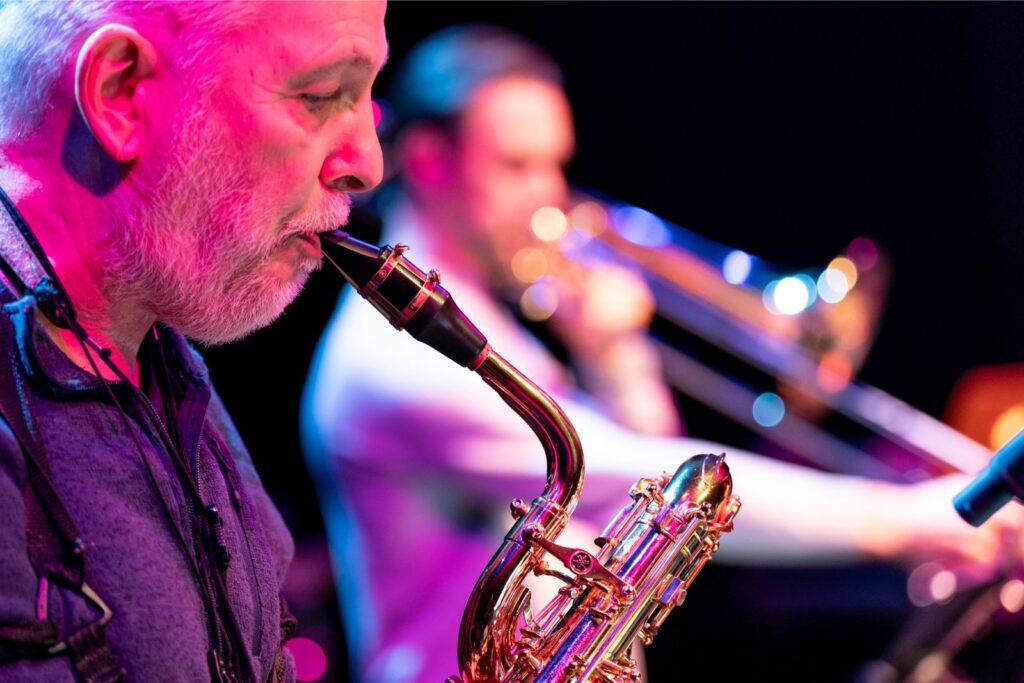 Michiel van Dijk, Anton van Houten
It’s getting too cold here for my daily walks, but when I do manage to get out, I’m happy to see the way the frost has redecorated the elms and sycamores; I like that the birds are fatter, and I can only recognize some of my neighbors from their eyes peeking out of their balaclavas. Soon, I’ll be grounded for weeks at a time, and I’ll have to turn my attention away from my little walking project and place my attention elsewhere. Luckily, I have Cracked Glaze, to revisit again and again.
Liner notes by Nate Wooley, a trumpet player, improvisor, composer, and writer dedicated to the American tradition of vibrantly shaggy experimentalism.
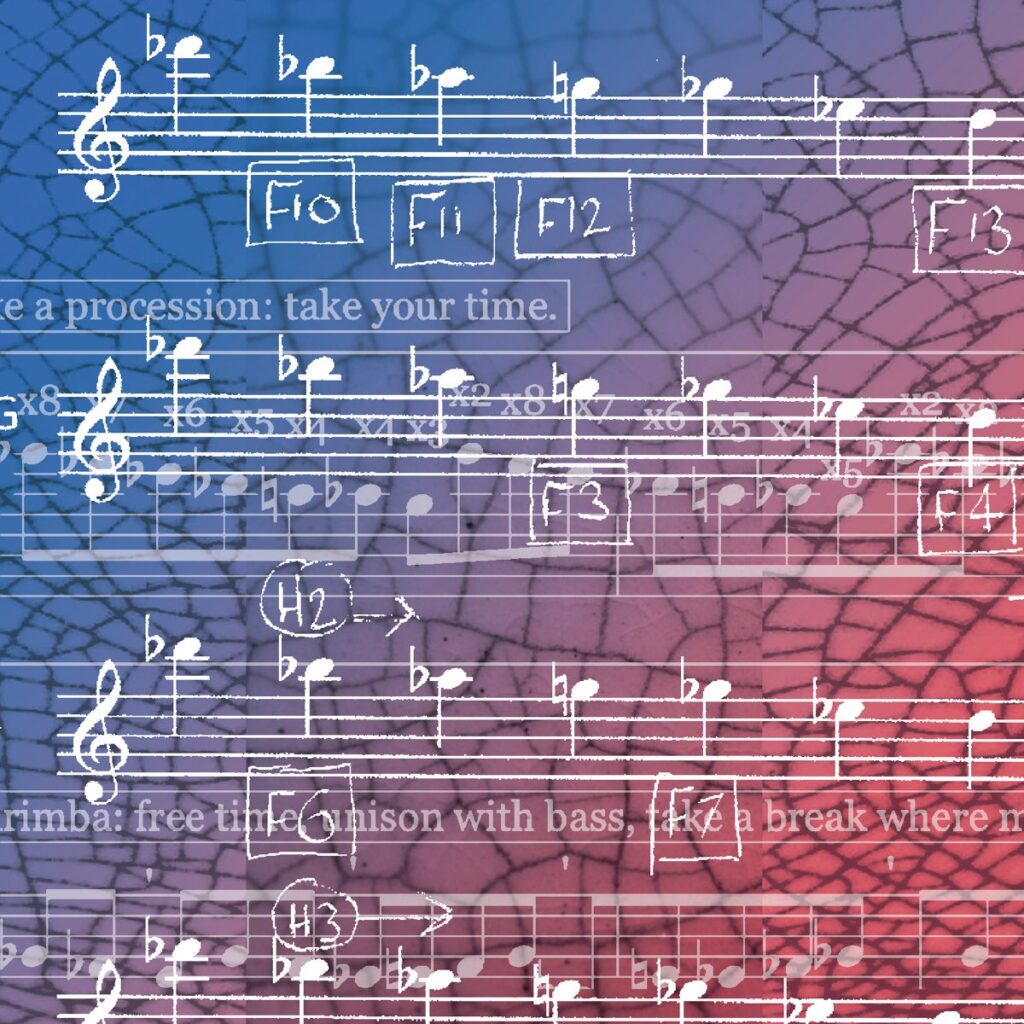 Front cover of the Cracked Glaze album
Words On Cracked Glaze
by Matthew Wright
In ceramics, a cracked glaze can occur during the firing process, when intense heat creates fractures, resulting in a tension between a smooth form and a tarnished surface. With Cracked Glaze I’m interested in how the elements of musical notation, improvisation and technology collide and ‘crack’ each other to produce catalytic results.
Commissioned by Ensemble Klang for their Musical Utopias festival in 2024, the project brings together a part-reading, part-improvising 12-piece group of Ensemble Klang, Spheric Totemic and Sofia Jernberg. This piece came out of a long period of planning in the autumn of 2023, an afternoon of rehearsal on the day of the premiere in January 2024, followed by a long period of mixing and post-production between autumn 2024 and autumn 2025. In essence what you hear on this release is the live recording from the premiere, mixed to exaggerate the sound field and bring out individual musical lines that were buried in the texture during the live performance. I think of this post-production process as like a repeat firing in ceramics: the material has undergone another layer of glazing, of cracking, of clarifying.
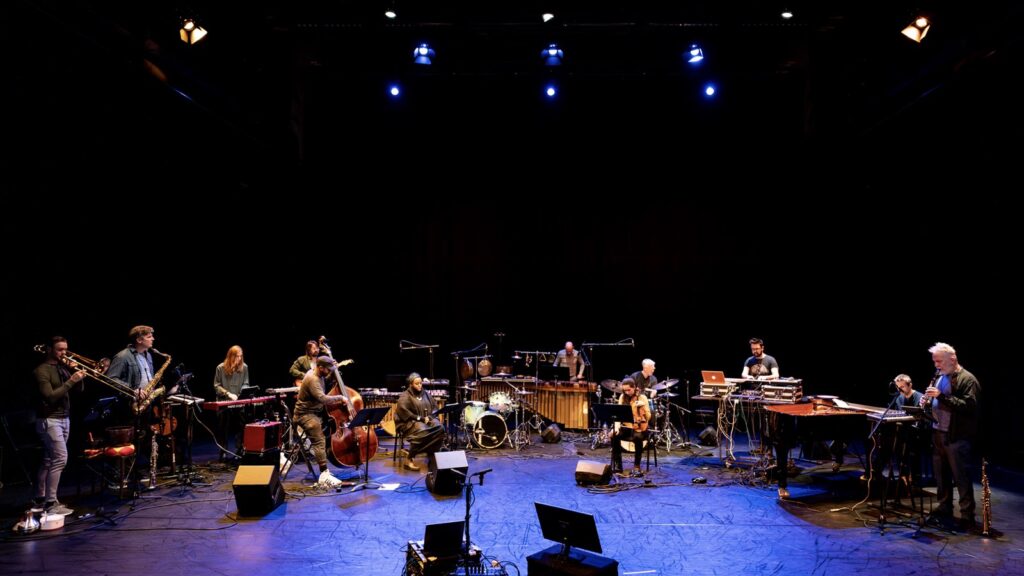 Sofia Jernberg, Spheric Totemic, and Ensemble Klang performing Cracked Glaze
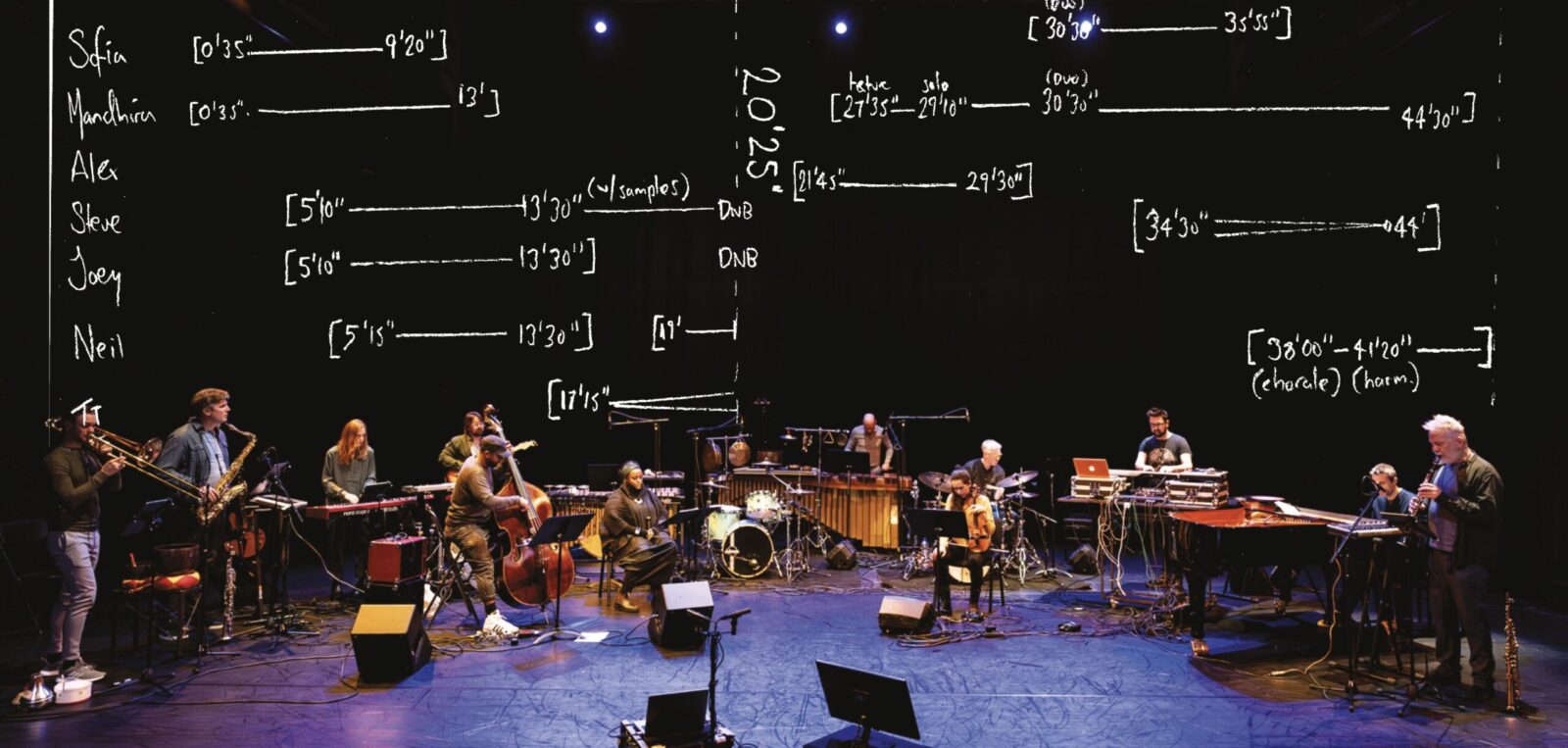
In terms of the notated material, the whole piece is built around a ‘spine’ of one long, descending scale (each note lasting five seconds and played on the guitar) that takes nineteen minutes to unfurl. This then repeats with some variations before finally settling on a four-note figure in the bass. The figure then evaporates into a coda of bass harmonics and glissandi in the brass. The whole process takes around forty-six minutes and I think of this as like a time-stretched version of a Tom Johnson Rational Melody. It becomes almost inevitable across the span of the piece and functions like a clean, ‘objective’ form in ceramics.
There are other layers of the notation that provide supporting roles: compressed fragments of the descending scale that appear as tiny melodies in the keyboards and vibraphone; hyper-compressed tremolos on keyboards; repeating cells and glissandi in the brass; and the concert bass drum sounding at key points in the structure. All of these elements are connected to exact points on a timeline and therefore would be more or less the same every time the piece is played. This could, in simplistic terms, be perceived as the ‘glaze’ in the title.
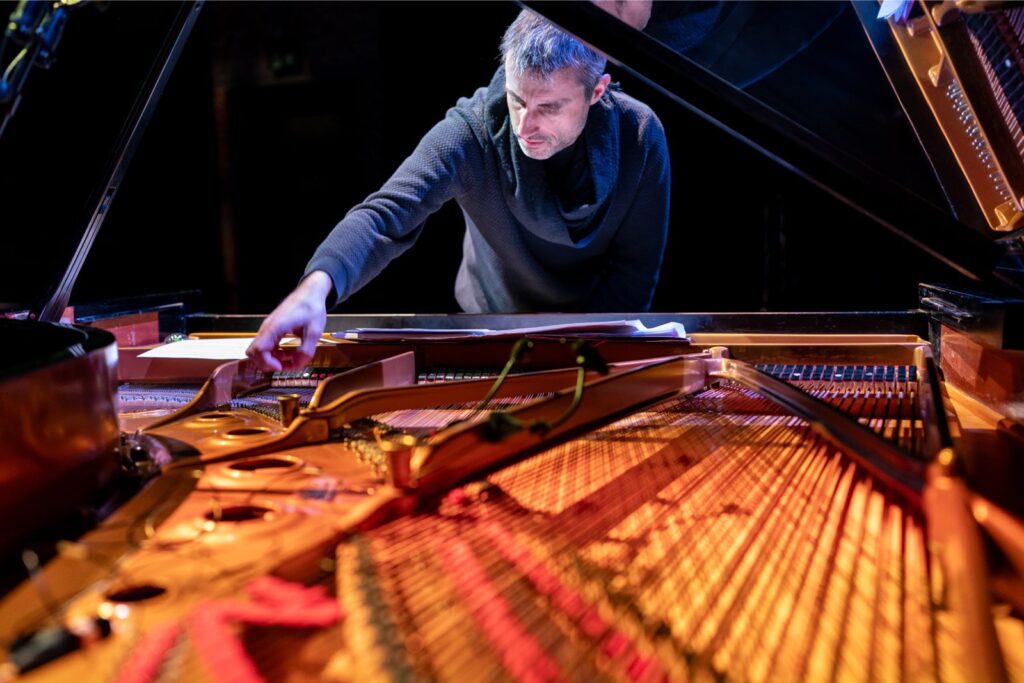 Alexander Hawkins
Superimposed against this notated ‘glaze’ are time-brackets (essentially start and stop times) for improvisors. The order of the improvisations is fixed with specific timings (first a duo between Sofia and Mandhira de Saram; then a duo between Stephen Davis and Joey Marijs, joined by Neil Charles; a solo from Alexander Hawkins, and then another duo from Sofia and Mandhira that becomes connected to a final solo from Neil) and these sections generally overlap/crossfade. Whilst these parameters are fixed, the musical material for the improvisors is generally not specified apart from the occasional suggestion, such as asking for Neil to play with bass harmonics at the end of the piece. These genius improvisors bring to the open instructions decades of collective intuitive experience, their musical languages cracking the glaze of my notation and throwing the music into a different direction, nodding to influences beyond notated music and way beyond Europe.
In the performance I took inputs of all of the improvisors, the saxophones and the trombone into my turntable/laptop setup, so that I could sample, process and sculpt the live sound design from the stage. In the final post-production ‘firing’ I was able to expand the sound field through reverbs, delays and panning, making the spaces in the music deliberately wider and deeper. Long sustained tones (made from extreme software time-stretching of the descending scale) were evident in the premiere recording, but in post I was able to give them more of a ‘sweeping/crossfading’ role, acting almost like changing light around the cracked glaze.
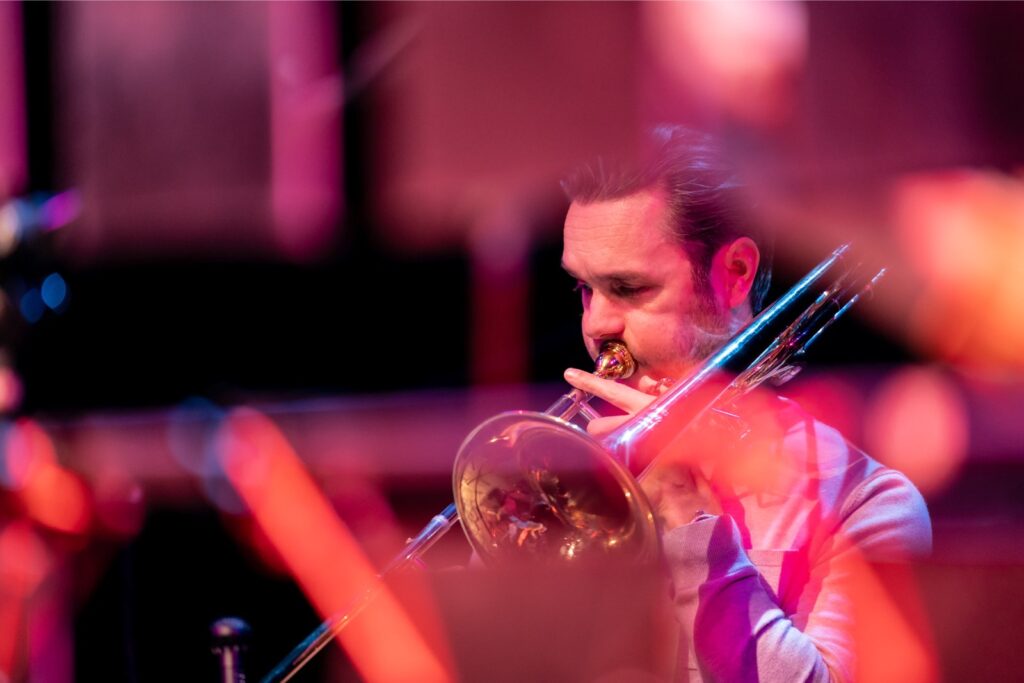 Anton van Houten
In some cases I have added samples (such as the drum kit ‘trio’ around 13.40) that didn’t exist in the original performance. There are even a few brief, surreal moments where I deliberately superimpose a soloist’s improvisation from the premiere with their solo from the afternoon rehearsal (something for the real close listeners!). For me this is the temporal equivalent of a spatial relationship: ‘present’ and ‘past’ recordings being heard simultaneously like the ability to see both the outside and inside of a ceramic bowl at the same time. This is not a fully-formed thought perhaps, but I certainly think visually/spatially when I am mixing: ‘feeling’ recordings as three-dimensional objects with angles, distances and apertures.
The title is a reference to the barst glazuur (cracked glaze) collection in the Kunstmuseum Den Haag that I have been lucky enough to visit many times, especially whilst I was a guest teacher at The Royal Conservatory in The Hague during the spring and summer of 2023. My huge thanks to CJ Mitchell of False Walls, Sofia Jernberg, my fellow musicians in Spheric Totemic (Alexander Hawkins, Neil Charles, Stephen Davis, Mandhira de Saram) and the incredible Ensemble Klang, who have supported my music for nearly two decades. My thoughts are with the family of Erik-Jan de With, who passed away suddenly in February 2025. He was an incredible light.
Matthew Wright is a composer, producer and sound designer based in Kent, UK.